
Blog
Waterless Diffuser for Office: The Complete Commercial Design Guide


Corporate facility managers are under increasing pressure to create work environments that support wellness and productivity without adding operational overhead. Traditional water-based diffusers, while common, introduce maintenance burdens: daily water changes, algae buildup, and the risk of hazardous mold spores in HVAC-connected spaces. For businesses managing large office footprints, the waterless diffuser for office model has quietly replaced the conventional ultrasonic tank as the default specification for commercial wellness design.
As the Lead Designer at PeersHome, I work directly with corporate architects and facility procurement teams to specify scent delivery hardware that integrates into premium commercial interiors. In this guide, I will break down the design and engineering logic behind industrial-grade waterless diffuser for office systems, covering cold-air atomization, material specification, and how to evaluate a supplier before committing to a bulk order.
1. Why Waterless Technology Solves the Corporate Maintenance Problem
A water-based diffuser serves a single desk well. Across an entire floor plate, the math falls apart. Standing water in an ultrasonic tank creates a biofilm within 48 hours if not cleaned. Multiply that by twenty devices across a workplace, and you have an unmanageable janitorial burden. A waterless diffuser for office eliminates the water reservoir entirely. Dry cold-air atomization uses high-pressure filtered air to convert pure fragrance oil into a sub-micron mist that drifts through the workspace without leaving condensation on desks, monitors, or acoustic panels.
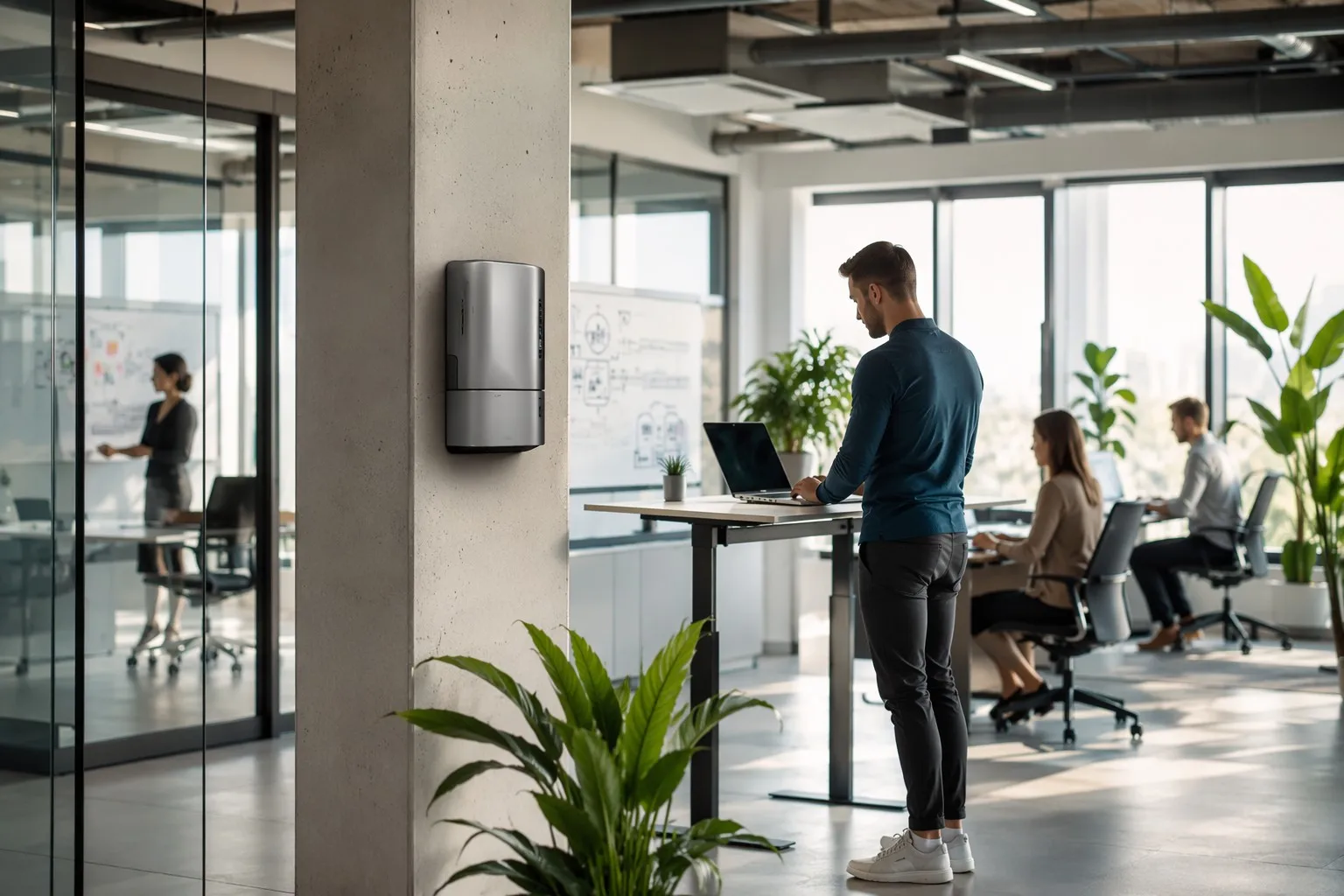
For offices participating in WELL or LEED certification, the absence of standing water is a measurable advantage. It eliminates one source of microbial risk from the indoor air quality audit trail. Facility teams can swap a fragrance canister every 30 to 60 days instead of performing daily tank cleaning, and the oil-only output means zero moisture is added to the already tightly controlled office humidity balance.
2. Coverage Math: Designing for Open-Plan Floors
A single waterless diffuser for office floor plates must handle between 5,000 and 15,000 cubic feet of air. The key variable is not just raw output but the uniformity of scent distribution. Poorly designed units create “hot spots” near the device and dead zones at the far end of a workstation row. Professional units solve this through a combination of nozzle geometry and programmable interval logic.
| Office Zone | Coverage Area | Recommended Interval | Scent Concentration |
|---|---|---|---|
| Reception / Lounge | Up to 5,000 cu ft | 15 sec run / 120 sec pause | High (First Impression) |
| Open Workstations | Up to 15,000 cu ft | 10 sec run / 90 sec pause | Medium (Subtle Focus) |
| Meeting Rooms | Up to 3,000 cu ft | 5 sec run / 200 sec pause | Low (Non-Distracting) |
| Breakout / Cafeteria | Up to 8,000 cu ft | 20 sec run / 150 sec pause | Medium-High (Energizing) |
For procurement teams, this table translates into hardware specification. A single lobby-grade unit can cover an entire open-plan floor when paired with the building’s HVAC system. Standalone units are more appropriate for private offices and small meeting rooms. A well-designed waterless diffuser for office deployment map should always specify the exact hardware per zone rather than assuming one model fits every space.
3. Material Specification: Aluminum Housings for Commercial Interiors
From a design perspective, the enclosure is not merely cosmetic. It must survive a commercial environment where cleaning crews use industrial solvents, and the device may sit in direct line of HVAC vents. I specify anodized matte aluminum for all our waterless diffuser for office enclosures. Aluminum does not yellow under UV exposure, resists chemical pitting from fragrance oils, and offers a matte texture that integrates seamlessly into modern office architecture.
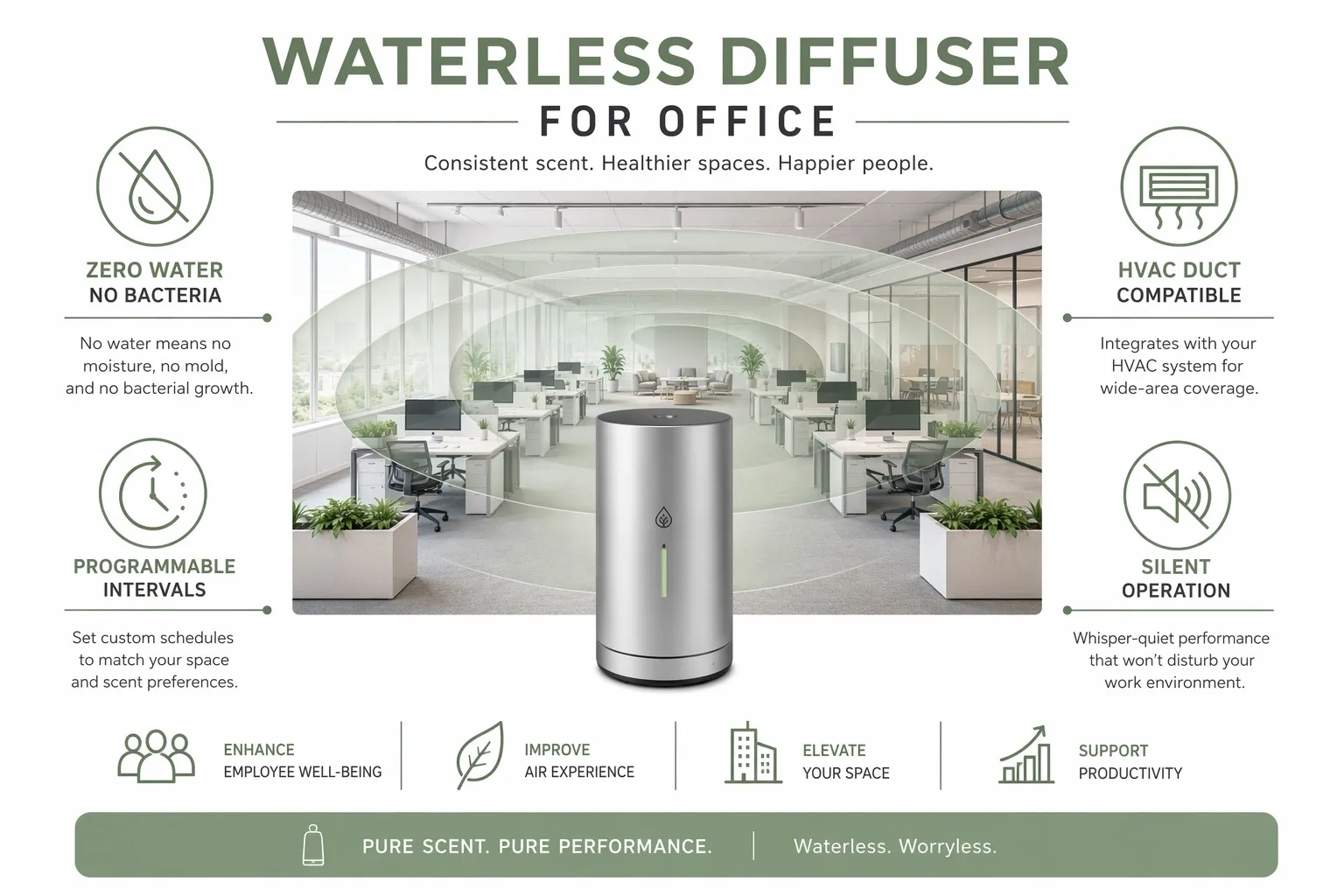
Plastic enclosures, by contrast, degrade in two predictable ways. First, essential oil concentrates act as solvents and will eventually craze or cloud polystyrene and low-grade ABS. Second, plastic retains static charge, attracting dust that must be wiped down frequently. For a procurement manager evaluating a three-to-five-year leasehold fit-out, the incremental cost of an aluminum housing pays for itself in reduced replacement cycles and lower cleaning costs.
4. Acoustic Engineering: Keeping the Office Quiet
A diffuser that hums or buzzes will be unplugged by the first employee who sits within earshot. This is the most common failure mode for office scenting programs. Professional waterless diffuser for office units use brushless air pumps with internal acoustic damping chambers. At PeersHome, we target a noise floor of 28 to 32 decibels, which is below the typical background noise of a ventilated office. An employee sitting three feet from the device should not be able to detect its operation.
When comparing suppliers, ask for a dated acoustic test report for the specific model, not a generic marketing claim. A pump that operates at 45 dB may seem quiet in a showroom but will be rejected in an actual workspace. This is the difference between a unit designed for commercial deployment and one adapted from a consumer product.
5. Programmable Logic: Matching Scent to Work Patterns
An office does not need the same scent intensity at 8:00 PM as it does at 10:00 AM. A waterless diffuser for office with a programmable microprocessor lets facility managers set multiple work periods per day. Some of our clients schedule a morning “activation” burst with citrus and rosemary notes and a lower-intensity afternoon profile that maintains focus without creating olfactory fatigue.
Beyond simple timers, look for units that support weekday and weekend scheduling natively on the device, without requiring a third-party app or cloud subscription. The device must operate reliably even when the office Wi-Fi is down for maintenance. This level of hardware independence is what separates a professional building system from a consumer smart device.
6. Supplier Selection: What to Ask Before Ordering
When evaluating a waterless diffuser for office wholesale partner, structure your questions around three categories: hardware reliability, fragrance documentation, and post-sale support. A supplier that can only answer price questions is unlikely to support a multi-year office fit-out.
- Can you provide an IFRA certificate and MSDS for the fragrance oils specifically formulated for your hardware?
- What is the rated lifespan of the internal air pump in continuous operation, and is the atomization head field-replaceable?
- Do you offer bulk canister ordering with scheduled replenishment to prevent stock outages?
- Can you support a pilot installation of 5 to 10 units before a full floor rollout?
7. Design Your Office Scent Program with PeersHome
At PeersHome, we design and manufacture architectural-grade scent delivery hardware built for the realities of commercial office management. Our waterless diffuser for office units combine durable matte aluminum enclosures, whisper-quiet air pumps, and programmable onboard logic into a maintenance-minimal device that fits naturally into premium workplace design.
See our related guides on Wholesale Waterless Diffusers for a deep dive into cold-air technology, or review our Hotel Lobby Diffuser Wholesale Guide to compare commercial scenting across different building types. For international safety standards, we recommend consulting the IFRA website.
Office environments are changing fast, and scent is increasingly part of the workplace equation. A well-specified waterless diffuser for office deployment reduces facility overhead, avoids the microbial risks of standing water, and contributes a subtle but consistent atmosphere that supports both focus and well-being. The hardware investment is relatively modest compared to the ongoing maintenance savings, and the employee experience improvement is immediate and measurable.
— Elena Rostova, Lead Designer
Get your custom design prototypes started. Send us your brand style guide.