


Blog
Private Label Aromatherapy Supplier: A Practical B2B Guide

Choosing a private label aromatherapy supplier is not simply a packaging decision. It affects your formula, margins, launch calendar, product claims, and customer experience. A supplier can offer attractive bottle photos and low minimum order quantities, yet still create problems with fragrance consistency, documentation, or replenishment.
For a growing wellness, hospitality, or home-fragrance brand, the right partner should make product development more predictable. This guide explains how to compare private label aromatherapy suppliers, what to ask before sampling, and how to structure a launch that can scale beyond the first purchase order.
What a Private Label Aromatherapy Supplier Should Actually Provide
A private label aromatherapy supplier should support more than filling a bottle and applying a sticker. The useful partner combines fragrance development, component sourcing, production control, quality documentation, and export coordination.
- Fragrance selection or custom scent development based on your target customer and use environment
- Compatibility checks between the fragrance, vessel, reeds, cap, closure, and label adhesive
- Clear sample, approval, production, and replenishment stages
- Transparent minimum order quantities, lead times, packaging costs, and shipping terms
- Batch records and product documentation appropriate to the market and product category

Start With a Written Fragrance Brief
Many sourcing mistakes begin before the first sample arrives. A vague request such as “something fresh and luxurious” leaves too much room for interpretation. A useful fragrance brief gives the supplier a commercial target.
Include the intended space, customer profile, preferred scent family, intensity, seasonality, reference products, target price, packaging format, and sales channel. A hotel lobby, a small bedroom reed diffuser, and a corporate gift set may use different scent strength and component specifications even when the fragrance direction is similar.
Define the commercial use case
Tell the supplier whether the product is intended for retail shelves, hospitality rooms, spa treatment areas, corporate gifting, or subscription fulfillment. The use case affects packaging durability, refill expectations, carton design, and the amount of product education required.
Separate scent direction from unsupported claims
Words such as cedarwood, white tea, citrus, and lavender describe a scent direction. Claims about treating anxiety, improving sleep, or preventing illness require a different level of evidence and regulatory review. A responsible private label aromatherapy supplier should help distinguish product description from a medical or therapeutic claim.
Evaluate Samples Like a Product Manager
Do not approve a fragrance from a blotter strip alone. A blotter helps compare the opening notes, but it does not show how the fragrance performs in the final format. Test the complete product with the selected bottle, reeds, closure, and label.
Record the date, sample code, fragrance name, component set, room size, and evaluator comments. Revisit the sample after one day, one week, and several weeks. This simple record helps your team distinguish a formula issue from a component issue or a change in room conditions.
| Evaluation area | What to check | Why it matters |
|---|---|---|
| Opening scent | First impression and intensity | Shapes the initial product experience |
| Dry-down | How the scent changes over time | Reveals whether the profile stays balanced |
| Diffusion | Reach and consistency in the intended room | Shows whether the format suits the use case |
| Component fit | Leaks, discoloration, swelling, or label lift | Prevents avoidable quality complaints |
| Replenishment | Repeatability of the approved sample | Protects future purchase orders |
Ask the Supplier About Fragrance Safety and Documentation
Documentation should match the product category and destination market. Ask which documents are available for the specific fragrance and finished product, rather than accepting a generic certificate that does not identify the formula or intended use.
The International Fragrance Association explains that its Standards provide a risk-management framework for the safe use of fragrance ingredients. You can review the IFRA Standards and safe-use framework when building your supplier checklist. For products that fall within cosmetics regulation, the U.S. Food and Drug Administration also provides a cosmetics labeling guide.
- Request the current safety and usage documentation for the intended application.
- Confirm the product category before approving claims or label language.
- Ask who is responsible for final-market label review: the supplier, the brand, or an external compliance adviser.
- Keep the approved formula, component list, artwork, and batch reference together.
Compare MOQ, Lead Time, and Reorder Terms Together
A low MOQ does not automatically produce a better deal. The supplier may offset it through higher component costs, setup fees, limited packaging choices, or a longer production queue. Compare the full landed cost and the conditions for the second order.
Ask for a written timeline covering brief confirmation, sample preparation, sample approval, artwork approval, component purchasing, filling, packing, inspection, and dispatch. Also ask whether the supplier can reserve the approved fragrance and packaging components for replenishment.
Questions worth asking before a purchase order
- What is the MOQ for a stock fragrance, and what changes for a custom fragrance?
- Which costs are one-time setup fees and which repeat on every order?
- How are shortages, damaged components, and approved artwork changes handled?
- Can the supplier support a pilot order before a larger production run?
- What is the expected reorder lead time after the first batch?
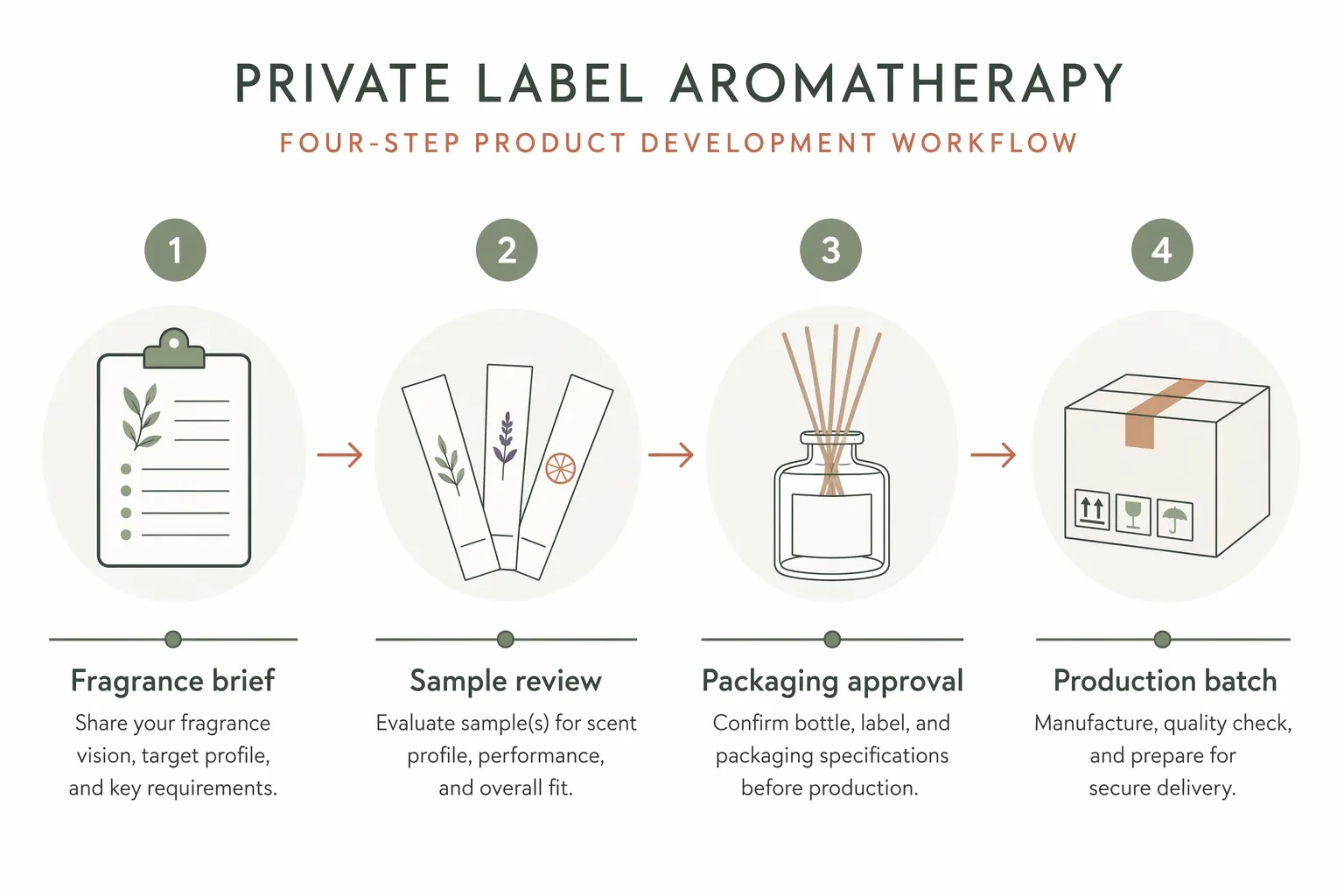
Build a Repeatable Approval Workflow
The strongest private label aromatherapy supplier relationships are built around written approvals. Use one approval record for the fragrance, one for the component set, and one for the packaging artwork. Include version numbers so an old label or discontinued bottle cannot accidentally return to production.
Before releasing the order, confirm the final sample against the approved record. After production, keep a retained sample and batch reference. This gives your customer service team something concrete to compare if a retailer or hospitality buyer reports a difference.
Private Label Aromatherapy Supplier Checklist
Use this short checklist when comparing suppliers:
- Can the supplier explain its sample-to-production process clearly?
- Are fragrance documentation and intended-use limits available for review?
- Can the supplier confirm bottle, reed, closure, and label compatibility?
- Are MOQ, lead time, setup charges, shipping terms, and reorder terms written down?
- Can the partner preserve consistency across future batches?
Plan the First Purchase Order Around Acceptance Criteria
Before production starts, agree on what counts as an acceptable finished unit. Define the fill level, bottle and cap appearance, label position, carton protection, scent reference, and the sample retained by both sides. A short acceptance sheet reduces subjective arguments after delivery and gives the supplier a clear quality target.
For a first launch, consider splitting the order into a controlled pilot and a larger replenishment. Use the pilot to confirm customer feedback, leakage performance, shelf presentation, and sell-through. Once the product earns repeat demand, the next order can use the approved sample and documented components instead of restarting development from the beginning.
Also confirm how changes will be communicated. A different reed, cap liner, fragrance concentration, or label adhesive can change the customer experience even when the product name remains the same. Written change control protects both the brand and the private label aromatherapy supplier from avoidable surprises.
Work With PeersHome on Your Next Fragrance Line
PeersHome supports fragrance brands, hospitality buyers, and wellness businesses with reed diffusers, essential oils, and scent delivery products. Review the PeersHome wholesale and OEM/ODM services for a starting point, then compare the difference between reed diffusers and scented candles before finalizing your product format.
A practical first step is to send a written brief with your target customer, room or use environment, preferred scent direction, package format, expected order volume, and destination market. That gives the supplier enough detail to recommend a realistic sampling and production path.
— Dr. Clara Vance, Fragrance Director
Looking to craft a signature blend for your brand? Reach out to our lab.






One thought on “Private Label Aromatherapy Supplier: A Practical B2B Guide”