
Blog
Custom Aromatherapy Diffusers: The B2B Guide to Design & Manufacturing


In a saturated wellness market, aesthetic differentiation is the primary driver of retail performance and brand recall. For emerging fragrance brands and hospitality groups, the transition from stock hardware to custom aromatherapy diffusers represents a critical shift from being a reseller to becoming a category leader. However, “customization” is often misunderstood as merely applying a logo. True B2B customization involves industrial engineering, material science, and iterative prototyping.
In this guide, we will analyze the technical pillars of developing custom aromatherapy diffusers, from material selection and internal component engineering to the strategic logistics of global OEM/ODM manufacturing.
1. Material Science: Selecting the Foundation for Your Brand Aesthetic
The exterior material of a diffuser is the first touchpoint for the customer. It dictates the product’s weight, perceived value, and durability. When designing custom aromatherapy diffusers, brands must choose materials that align with their positioning and environmental commitments.
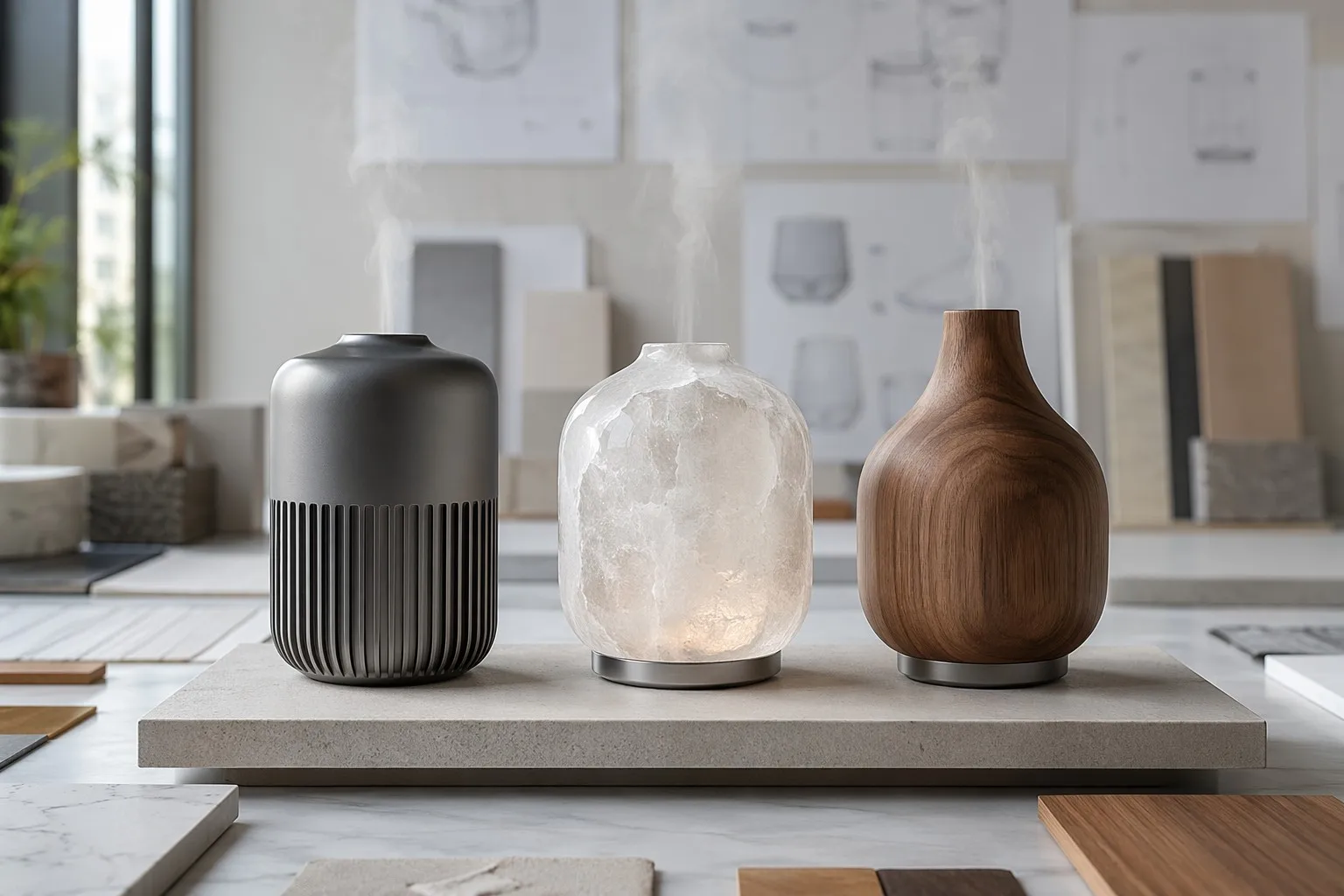
Anodized Matte Aluminum
For brands targeting a modern, tech-forward, or “digital detox” aesthetic, anodized aluminum is the gold standard. It is lightweight, 100% recyclable, and offers superior resistance to the corrosive nature of highly concentrated essential oils. The anodization process allows for precise color matching to a brand’s palette, providing a finish that synthetic polymers cannot replicate.
Sustainable Hardwoods (Walnut and Oak)
In the “Japandi” and minimalist design space, sustainable wood remains a top choice for custom aromatherapy diffusers. FSC-certified walnut or oak provides a warm, organic feel that grounds the user’s space. In B2B design cycles, we prioritize wood-grain consistency and moisture-resistant internal liners to prevent the housing from warping or absorbing fragrance oils over time.
Salt-Style and Frosted Glass
Glass offers a timeless, premium translucency. When combined with LED telemetry, salt-style glass creates a therapeutic “glow” effect that is highly effective for sleep-focused wellness brands. From an engineering perspective, glass is the most inert material, ensuring zero chemical interaction with the fragrance formulation.
2. Industrial Engineering: The Internal Mechanics of Customization
Beyond the shell, the true value of custom aromatherapy diffusers lies in the internal hardware. Relying on generic internal kits often leads to high failure rates and inconsistent scent delivery. High-performance customization requires deep attention to the following components:
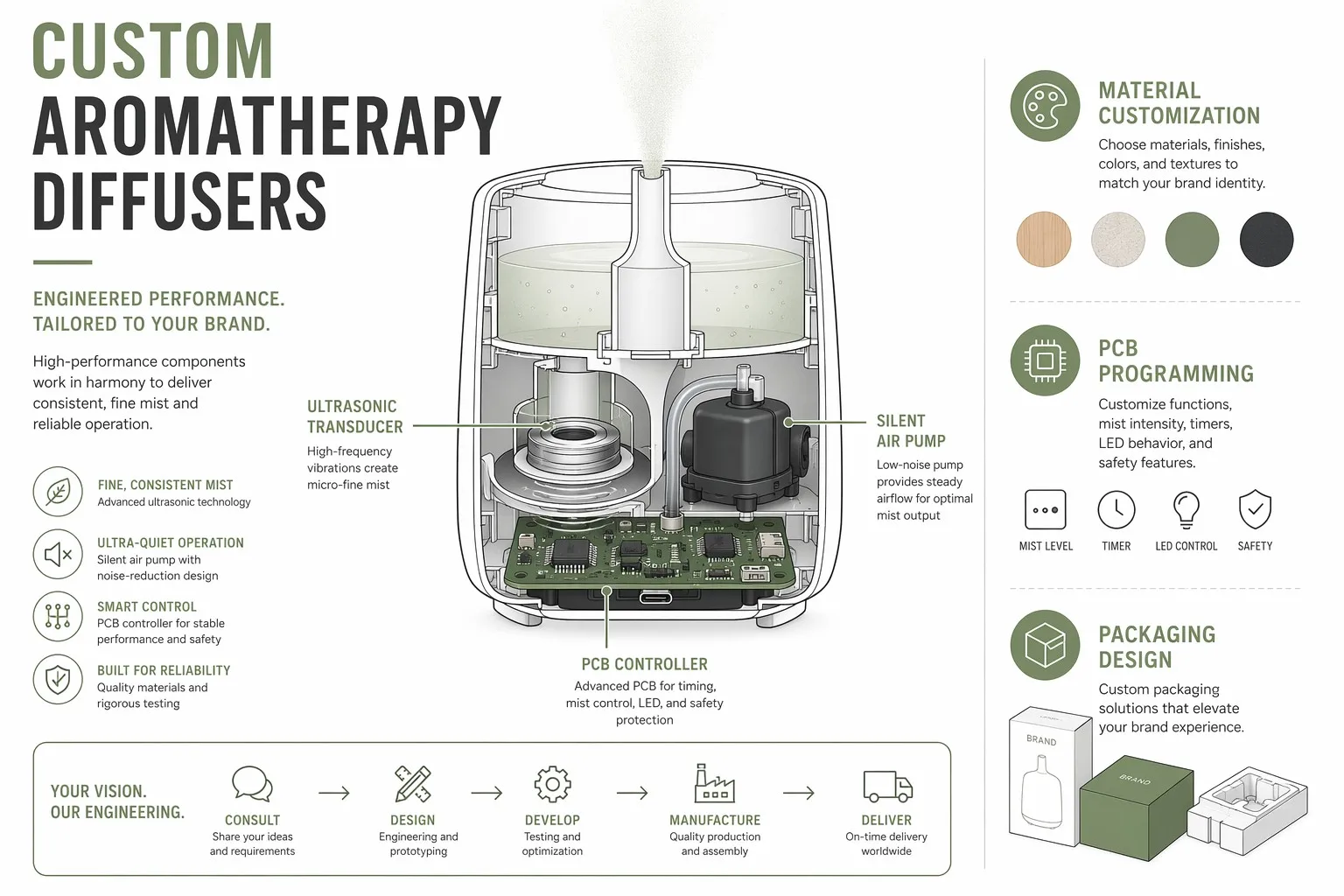
- Ultrasonic Transducers: High-frequency ceramic discs that determine the mist particle size. For premium brands, we specify transducers that produce a “dry” mist under 5 microns, preventing damp residue on furniture.
- Silent Air Pumps: In professional environments like spas or hotel rooms, noise is a dealbreaker. We engineer internal damping systems to keep decibel levels below 30dB.
- PCB Programming: Custom Printed Circuit Boards allow brands to define their own interval timers, light intensity levels, and auto-shutoff safety protocols.
3. The B2B Development Workflow: From Brief to Production
Successful custom aromatherapy diffusers are the result of a disciplined design and manufacturing process. Working with a dedicated OEM/ODM partner like PeersHome ensures that every stage of development is documented and verified.
| Phase | Deliverables | Timeframe (Avg) |
|---|---|---|
| Design Brief | ID Sketches, Color/Material/Finish (CMF) Specs | 1-2 Weeks |
| 3D Prototyping | SLA/CNC Functional Models | 2-3 Weeks |
| Tooling & Molding | Steel Molds for Mass Production | 4-6 Weeks |
| Trial Production | First Article Inspection (FAI) Units | 2 Weeks |
| Mass Production | Quality Controlled Batch Delivery | 3-4 Weeks |
4. Navigating Compliance: Certification Standards for Custom Aromatherapy Diffusers
When mass-producing custom aromatherapy diffusers for international markets, navigating the legal requirements is as important as the design itself. North American and European retailers require specific certifications to ensure that the electronic components are safe for long-term use. For your brand, failure to provide documented compliance can lead to shipping delays or product recalls.
- CE and RoHS: Essential for the European market, verifying that the device meets health, safety, and environmental protection standards and does not contain restricted hazardous substances.
- FCC Certification: Required for any electronic device sold in the United States, ensuring that the electromagnetic interference from the diffuser is within limits approved by the Federal Communications Commission.
- UL Listing: While not always mandatory, a UL-listed power adapter provides a significant layer of trust for B2B buyers and commercial insurers, confirming that the electrical system has been rigorously tested for fire and shock safety.
5. Packaging and Unboxing: Extending the Custom Experience
For e-commerce and retail brands, the unboxing experience is part of the product. When ordering custom aromatherapy diffusers, packaging should not be an afterthought. We recommend rigid gift boxes with custom-molded pulp or EVA foam inserts to ensure the hardware survives global shipping while conveying luxury. Sustainability-focused brands should opt for soy-based inks and recycled kraft materials to align their packaging with their “green” product claims.
6. Case Study: Material-Based Branding for Boutique Hotels
To understand the commercial impact of custom aromatherapy diffusers, we can look at the recent hospitality trends in Western Europe and North America. Boutique hotel groups are moving away from standard plastic units that clash with premium interior design. By selecting handcrafted ceramic or matte aluminum housings, these properties turn a functional utility into a design feature. In one recent project, a lifestyle hotel brand in Scandinavia saw a measurable increase in guest scent recall simply by matching the diffuser’s texture to the lobby’s architectural basalt accents.
This level of alignment requires a supplier that understands color-material-finish (CMF) workflows. When your custom aromatherapy diffusers reflect the physical language of the space, the sensory experience becomes seamless. The scent is no longer perceived as an external addition, but as an inherent property of the brand environment.
7. Maintenance and Longevity: Ensuring B2B Reliability
A common failure point for wellness brands is the high return rate of poorly engineered hardware. For a B2B partner, a broken diffuser is not just a lost sale; it is a damaged relationship. When we develop custom aromatherapy diffusers at PeersHome, we focus on ease of maintenance. This includes easy-to-clean reservoirs, replaceable atomization heads, and anti-clogging internal filters. By designing for longevity, you reduce the total cost of ownership for your commercial clients and build a reputation for industrial-grade reliability.
We recommend providing your B2B buyers with a clear maintenance schedule. Regular cleaning of the ultrasonic transducer with a soft cloth and high-purity isopropyl alcohol ensures that the scent distribution remains consistent over thousands of hours of operation. A well-maintained custom unit can last up to three times longer than a generic consumer model, providing superior ROI for hospitality and retail environments.
8. Precision Programming: Optimizing Scent Intensity and Intervals
One of the technical advantages of developing custom aromatherapy diffusers is the ability to program bespoke operational intervals. In B2B contexts, such as a 24-hour hotel lobby versus a 9-to-5 corporate office, the scent delivery requirements vary significantly. By customizing the PCB logic, we can enable “Smart Intensity” modes that adjust diffusion frequency throughout the day. This not only preserves the longevity of expensive essential oils but also ensures that the scent level is always optimized for the current human traffic density.
For example, a wellness-focused brand can pre-program a “Morning Focus” mode with rapid bursts of high-intensity citrus notes and an “Evening Calm” mode with long-interval lavender diffusion. This level of software customization elevates your product from a simple hardware device to an intelligent sensory marketing tool that provides genuine value to commercial operators.
9. Global Logistics: Shipping and Distribution of Bulk Custom Orders
Manufacturing custom aromatherapy diffusers is only half of the journey; getting them to your global fulfillment centers safely is the second half. Since these units often feature delicate materials like glass or precision electronic components, the palletization and shipping strategy must be robust. We utilize drop-tested B2B outer cartons and moisture-controlled sea freight containers to ensure that your custom batches arrive in pristine condition, regardless of the destination.
Furthermore, we support DDP (Delivered Duty Paid) shipping to major markets in North America and Europe, handling all customs clearances and import duties on your behalf. This “hands-off” logistics model allows your brand team to focus on marketing and sales while we manage the complex supply chain operations behind your custom product rollout.
10. Why Partner with PeersHome for Custom Diffuser Projects?
At PeersHome, we act as the bridge between visionary brand designers and high-precision industrial manufacturing. Our experience in developing custom aromatherapy diffusers for global wellness franchises and boutique fragrance houses allows us to navigate the complexities of material compatibility and compliance (CE/FCC/RoHS) effortlessly.
We provide full-service support, including industrial design (ID), mechanical design (MD), and supply chain management. Whether you are looking for a low-MOQ pilot project or a high-volume global rollout, our team ensures that your scent vision is translated perfectly into a tangible, high-performance product.
Ready to start your design journey? Read our recent guide on Private Label Aromatherapy Suppliers to understand the foundational steps, or explore our Wholesale Waterless Diffusers to see our latest cold-air technology in action. For international safety standards, we recommend consulting the IFRA website.
— Elena Rostova, Lead Designer
Get your custom design prototypes started. Send us your brand style guide.